
How to Properly Analyze Your AWS Costs? – When it comes to running a business there are a lot of factors to consider. One of the most important things that can make a brand competitive is its online presence. With the rise of the modern age and the advancements that technology has afforded, the digital world has become paramount to success. Even when it comes to aspects of marketing, the internet has created a consumer that has never existed in the history of mankind. People now have more access to information, brands, and options for any goods or services they could want than ever before.
While there are a lot of factors that go into making a brand competitive and winning over customers, an online presence is one of the most important. One of the ways that businesses can achieve this, whether it’s running their web services, or creating and launching apps, is through AWS.
Table of Contents
What is AWS?
AWS stands for Amazon Web Services and is one of the largest and most used cloud platforms in the world. This web service has over 200 full functional features to offer developers and is used by a variety of different clients. New, fast-growing startups and established enterprise-sized companies alike use AWS to see their vision come to reality.
There are a lot of reasons why this web service, in particular, is so popular and so well loved. For starters, it’s a massive web service and has a rich catalog of features. On top of the most important core features like data analysis, computing power, and data storage, there are tools in new technologies that companies can take advantage of, like artificial intelligence and machine learning. It’s not only one of the largest web services on the market but it is also one of the most secure. There is even the advantage of the ecosystem in using AWS as there is a wide variety of Amazon-designed and AWS-friendly tools on the market, like Amazon ECS.
Specialists Who Help Organizations Analyze AWS Costs
Organizations often rely on specialists to analyze and optimize AWS spending. These professionals typically work in cloud architecture, FinOps, and DevOps roles.
| Specialist Role | Key Responsibility | Tools Used | Average Annual Salary (Global) |
|---|---|---|---|
| Cloud Financial Analyst | Monitor cloud expenses and cost allocation | AWS Cost Explorer, FinOps tools | $90,000 – $120,000 |
| DevOps Engineer | Optimize infrastructure and automation | Terraform, AWS CLI, CloudWatch | $100,000 – $140,000 |
| FinOps Engineer | Financial governance of cloud spending | FinOps platforms, Cost Explorer | $110,000 – $150,000 |
| Cloud Architect | Design cost-efficient cloud architecture | AWS Pricing Calculator, Architecture tools | $120,000 – $160,000 |
| Infrastructure Engineer | Manage workloads and instance usage | AWS EC2, Lambda, S3 | $95,000 – $130,000 |
These professionals ensure that cloud environments are efficient, scalable, and cost-controlled.
AWS Pricing Models and Estimated Costs for Major Services
AWS pricing is based on a pay-as-you-go model, meaning businesses only pay for the resources they consume. However, different services have varying pricing structures.
| AWS Service | Example Price (2026 estimate) | Pricing Model |
|---|---|---|
| Amazon EC2 (Compute) | $0.0116/hour for t3.micro | Pay per hour |
| Amazon S3 Storage | $0.023 per GB/month | Storage based |
| AWS Lambda | $0.20 per million requests | Usage-based |
| Amazon RDS | $0.017/hour (basic instance) | Instance pricing |
| Data Transfer (Internet) | From $0.09 per GB | Bandwidth-based |
Data transfer costs can significantly increase cloud spending, especially when transferring data across regions or outside AWS networks.
Businesses must monitor these costs carefully because data transfer and compute workloads often represent the largest cloud expenses.
Major AWS Cloud Regions and How Location Impacts Cloud Pricing
AWS operates dozens of global regions, and pricing can vary depending on the location due to infrastructure, electricity, and operational costs.
| AWS Region | Region Code | Cost Level | Typical Use Case |
|---|---|---|---|
| US East (N. Virginia) | us-east-1 | Lowest | Global services |
| US West (California) | us-west-1 | Medium | AI workloads |
| Europe (Ireland) | eu-west-1 | Medium | European compliance |
| Asia Pacific (Mumbai) | ap-south-1 | Medium | India-based services |
| Asia Pacific (Sydney) | ap-southeast-2 | High | Australian deployments |
Different regions can have significant pricing differences, and choosing the right location can reduce cloud costs considerably.
Organizations should balance latency, compliance requirements, and cost when selecting deployment regions.
Comparing AWS Cost Analysis Tools
Below is a comparison of major AWS cost analysis tools used by organizations.
| Tool | Purpose | Key Feature |
|---|---|---|
| AWS Cost Explorer | Cost visualization and analytics | Historical cost tracking |
| AWS Budgets | Spending control | Alerts for budget limits |
| AWS Pricing Calculator | Cost estimation | Workload pricing simulation |
| AWS Cost and Usage Report | Detailed billing data | Advanced reporting |
| Third-Party FinOps Tools | Cost optimization | Multi-cloud visibility |
AWS Cost Explorer allows users to analyze spending for up to 13 months and forecast future costs, making it a core tool for financial analysis in the cloud.
Recent updates also introduced automated cost comparisons between months, allowing organizations to identify sudden increases in spending quickly.
Is AWS Affordable?
One of the biggest reasons that AWS has such a variety of users from startups that launched yesterday to established enterprise-sized companies, is the fact that it doesn’t employ a tier-based pricing system. Instead, runs a pay-as-you-use style billing system that only charges you for what you actually utilize. This works just like utilities, paying for electricity or water. This allows smaller businesses to capitalize on only paying for what is absolutely necessary.
However, just like with utilities, there is a responsibility to keep tabs on consumption. In the middle of the winter, if a window is left open, the heating bill is going to run up. Comparatively, if the windows are shut and the house has good insulation, the heating bill would be drastically less. In the same way, AWS costs need to be monitored closely, because they can quickly get out of hand.
To a degree, this comes down to the nature of the digital world. Creating websites, and applications, and launching them into the market is not an easy thing to do. Data aggregation and analysis, utilizing lake houses and warehouses, all require skill and knowledge to do well. There are always going to be ways that if not checked carefully, a process could be pulling unnecessarily from AWS and running up the ‘bill’.
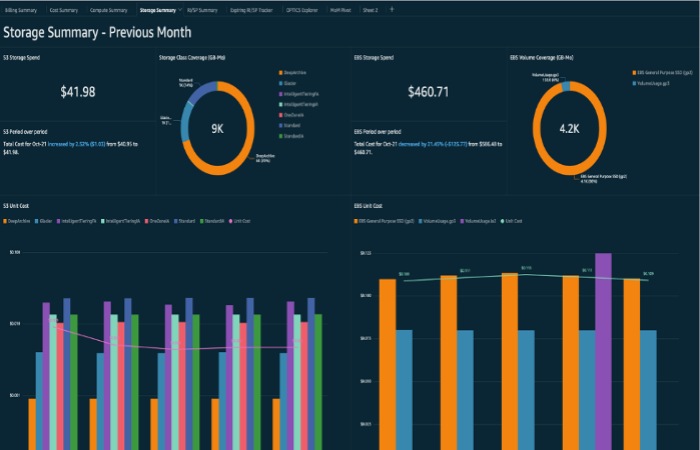
This is why AWS cost monitoring is so important. It allows businesses to have insight into their consumption to ensure that they don’t run over budget. Unfortunately, however, it’s not always as easy as just checking to make sure the proverbial doors and windows are closed. Amazon’s native AWS cost explorer will give a detailed report of energy consumption, however, the problem lies in accessibility. Often times these reports are extremely technical and can be challenging for non-technical employees to understand.
The Proper Analysis – Should Be Simple
When it comes down to it, the proper way to analyze your AWS costs should be simple. This is because both your technical as well as non-technical employees are vital to your company’s success, and allowing department heads to see in-depth, digestible reports on AWS costs can help to formulate more effective means of savings.
By helping your entire team understand the complexities of an AWS cost explorer report without losing any of the deep analytical insight, you bring more minds to the table when it comes to solutions. Things like daily averages, weekly averages, and even monthly averages shouldn’t be something that takes one of your engineers to understand and communicate. With reports that can be easily accessed by department heads, and emailed in PDF format for easy sharing, finding cost-effective ways to run your AWS will never be more attainable.
Expert Reviews and Industry Feedback
Industry experts and cloud engineers consistently emphasize the importance of monitoring AWS costs.
Positive Feedback
-
Provides detailed usage insights
-
Supports forecasting and budgeting
-
Scales well for large enterprises
Challenges
-
Billing structure can be complex
-
Hidden costs such as data transfer
-
Requires technical expertise for optimization
Many cloud professionals recommend implementing FinOps frameworks to maintain financial accountability across engineering teams.
Case Study: How Businesses Reduced AWS Costs Between 2025 and 2026
Company Example: SaaS Startup Scaling on AWS
A growing SaaS company analyzed its AWS usage between 2025 and 2026 to reduce unnecessary spending.
| Year | Monthly AWS Cost | Optimization Actions |
|---|---|---|
| 2025 Q1 | $12,000 | Initial infrastructure setup |
| 2025 Q3 | $18,500 | Increased workloads |
| 2025 Q4 | $16,200 | Implemented reserved instances |
| 2026 Q1 | $14,000 | Optimized storage and removed unused resources |
| 2026 Q2 | $12,800 | Implemented automation |
Conclusion
Analyzing AWS costs is essential for maintaining financial control in modern cloud environments. Without proper monitoring, organizations can easily overspend due to unused resources, inefficient architecture, or unexpected data transfer charges.
By using tools such as AWS Cost Explorer, AWS Budgets, and the AWS Pricing Calculator, businesses can gain valuable insights into their spending patterns and forecast future costs. These tools help organizations identify cost spikes, optimize infrastructure, and implement smarter cloud strategies.
In the coming years, cloud financial management will continue evolving with automation, AI-driven analytics, and advanced FinOps practices. Organizations that actively monitor and optimize their AWS usage will achieve better performance, scalability, and cost efficiency.
Disclaimer
This article is for educational and informational purposes only. AWS prices, features, and services may change over time depending on the region, usage patterns, and AWS policy updates. Always consult official AWS documentation or financial advisors before making infrastructure or financial decisions.
Also read: What Young People Can Face On The Internet?
