
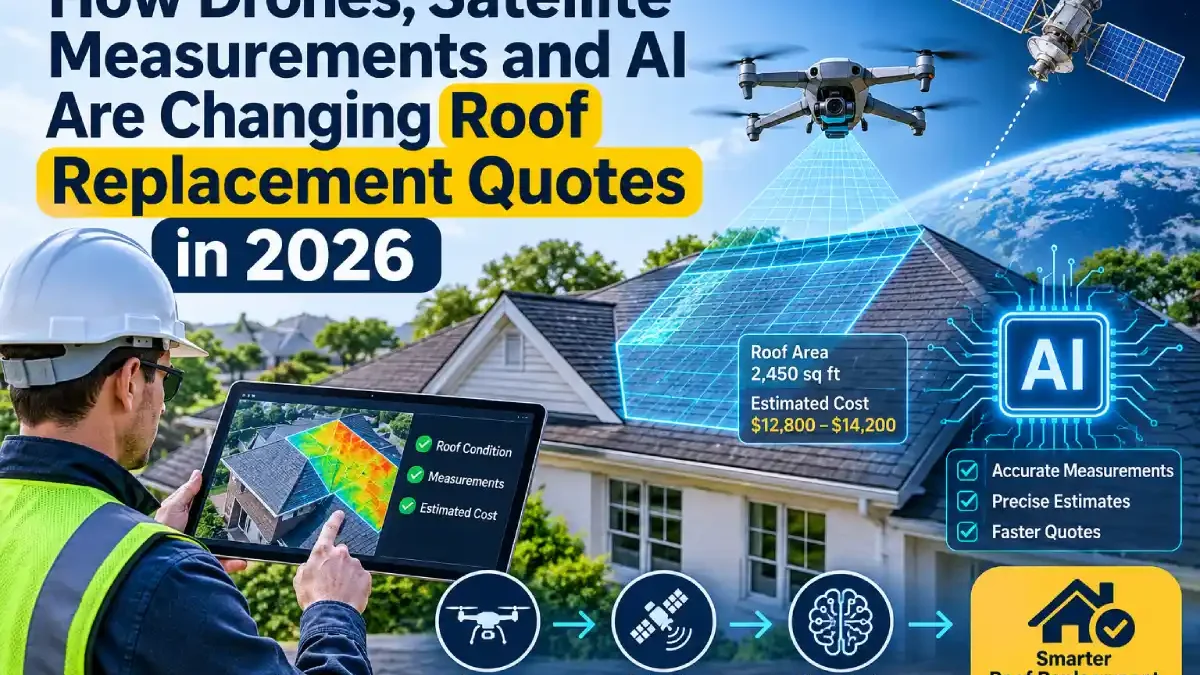

For decades, getting a roof replacement quote meant the same routine. A contractor climbed a ladder, walked the roof with a tape measure, took a few photos and wrote a number on a form a few days later. Today that process looks very different. Drones, aerial imagery and software now do much of the measuring and documenting, and homeowners get more data than ever before they sign anything.
This matters because a roof is one of the largest expenses a homeowner faces. Better technology does not make a roof cheaper on its own. It does make the quote easier to understand, easier to compare and harder to inflate. Here is how the main tools work, what they can and cannot do, and how to use them to plan a realistic budget.
Table of Contents
Drone inspections: a closer look without the ladder
Drones have become a standard inspection tool for many roofing companies. A small camera drone can capture high resolution photos and video of every slope, valley, flashing detail and chimney in minutes.
For homeowners, the benefits are practical:
- Steep or fragile roofs (slate, clay tile, older wood shakes) can be documented without anyone walking on them and causing more damage.
- You see exactly what the contractor sees. Good companies share the footage and point to specific problems, such as cracked tiles, lifted shingles or failing sealant around vents.
- A record. Dated images are useful for insurance claims and for comparing the roof’s condition over time.
In the United States, anyone flying a drone for commercial work must hold an FAA Part 107 remote pilot certificate. It is a fair question to ask any contractor who offers drone inspections.
Drones have limits. A camera cannot see rot under the shingles, soft decking or moisture trapped in insulation. A good inspection still combines aerial images with a hands-on check in the attic and at key points on the roof.
Satellite and aerial measurements: the end of guesswork
Measurement used to be one of the biggest sources of error in roofing quotes. Today, many contractors order roof measurement reports built from high resolution aerial and satellite imagery. These reports calculate total roof area, the pitch of each slope, and the length of ridges, valleys, hips and edges.
Why this helps you:
- Fewer surprises. Material quantities are based on measured area plus a waste factor, not a rough estimate.
- Easier comparisons. If two contractors quote very different square footage for the same house, you know to ask why.
- Faster quotes. Some companies can prepare a preliminary estimate before they ever visit the property.
The main caveat is that imagery shows the surface, not the structure. Tree cover, recent additions and complex rooflines can reduce accuracy. Treat a remote measurement as a strong starting point and expect the contractor to confirm it on site.
AI estimating tools: faster numbers, same fundamentals
The newest layer is a software that turns measurements and photos into a cost estimate. Some tools detect roof features from images, apply local material and labor prices, and produce a quote range within minutes. Many contractors also use estimating software to build line-item proposals.
These capabilities rely on data analysis and machine-learning techniques that are useful for one thing above all: getting a ballpark early, so you can plan. They are less reliable at the details that drive the final price, such as:
- The condition of the decking under the old roof
- How many layers of old roofing must be removed
- Local permit fees and inspection requirements
- Access issues, like steep pitches, narrow streets or limited parking for equipment
- Code upgrades required when a roof is replaced
An online estimate is a planning tool, not a contract. The written quote after an in-person inspection is the number that counts.
Why location still decides the final number
Technology can measure a roof anywhere, but it cannot change local conditions. Labor rates, permit rules, building codes and even weather vary from city to city, and they shape the final cost as much as the roof’s size.
Dense urban areas are a good example. In a city like San Francisco, steep lots, attached homes, older housing stock and strict permit requirements can all add time and cost to a project. If you live in the Bay Area, a local breakdown of San Francisco roof replacement costs will give you a far more realistic picture than a national average or a generic online calculator.
The same principle applies everywhere. Use technology to understand your roof, then use local knowledge to understand your price.
How to use roofing tech to plan a smarter budget
Here is a simple process that combines the best of both worlds:
- Start with a remote estimate. Use an online tool or a contractor’s preliminary quote to get a rough range. This tells you whether to plan for a repair, a partial replacement or a full reroof.
- Ask for the measurement report. Request the total area, pitch and waste factor used in the quote. Compare these numbers across contractors.
- Request drone or photo documentation. Ask to see the images that support each recommendation. Clear evidence makes it easier to separate necessary work from upselling.
- Confirm the hidden items. Ask how the contractor handles damaged decking, tear-off of old layers and permits. These are the line items most likely to change the final price.
- Compare full quotes, not just totals. Look at materials, warranty terms, underlayment, ventilation and cleanup. Two quotes with the same total can deliver very different roofs.
- Plan a buffer. Set aside a contingency for problems that only appear once the old roof comes off.
Questions to ask a contractor who uses these tools
- Who flies your drone, and are they Part 107 certified?
- Can I get a copy of the measurement report and the inspection photos?
- Is this estimate based on remote data only, or on an on-site inspection?
- What items in this quote could change after tear-off, and how will you price them?
- Are permit fees included?
A contractor who welcomes these questions is usually a contractor who stands behind the numbers.
The bottom line
Drones, aerial measurements and AI estimating tools have made roof replacement quotes faster, more transparent and easier to compare. They give homeowners data that used to stay on the contractor’s clipboard. But they do not replace a hands-on inspection, and they cannot account for local labor, permits and codes on their own.
The smartest approach is to use technology to get informed early, then rely on a qualified local roofer for the final assessment. That combination is what turns a rough estimate into a budget you can trust.
