
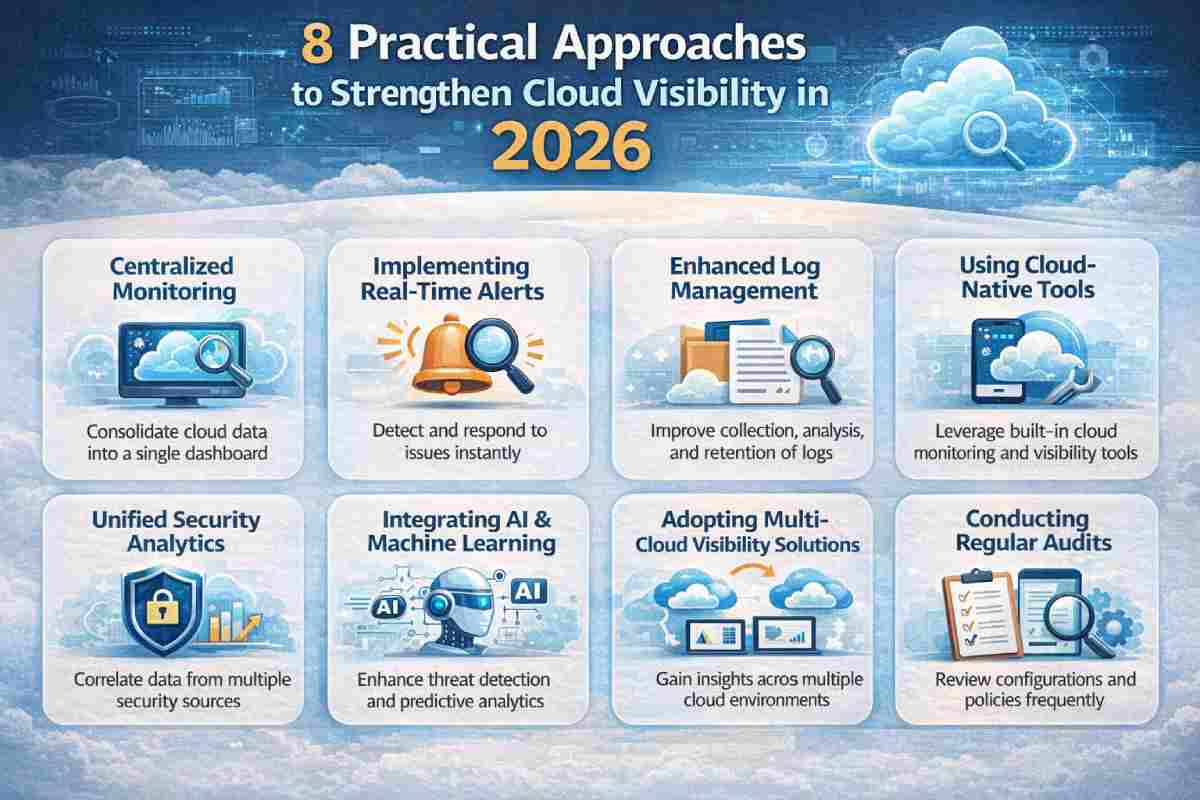
Cloud use is growing as businesses adopt hybrid systems, SaaS apps, and multiple clouds. This boosts innovation but makes it harder to track users, resources, and data flows.
Without clear visibility, security teams can’t track assets, access, or data flows. Enhancing cloud visibility is crucial for security and monitoring in 2026.
Table of Contents
Why Cloud Visibility is Increasingly Challenging
Modern cloud environments change quickly, with services deploying in minutes, containers scaling automatically, and third-party tools integrating fast, often creating blind spots.
Some common visibility challenges include:
| Challenge | Cause | Impact |
| Multi-cloud complexity | Different cloud providers log and structure data differently | Correlating activity across environments is difficult |
| Shadow SaaS usage | Teams adopt tools without security review | Sensitive data flows outside monitored systems |
| Ephemeral workloads | Containers and functions spin up and down rapidly | Logs and configuration data may be incomplete |
| Identity sprawl | Roles, tokens, and service accounts accumulate over time | Access tracking becomes difficult |
| Tool fragmentation | Separate platforms monitor network, cloud, and SaaS | Cross-domain threats can go unnoticed |
| Configuration drift | Frequent deployments cause unplanned changes | Security posture may deviate from policies |
| Limited east–west visibility | Internal cloud traffic bypasses traditional controls | Lateral movement is harder to detect |
Organizations that don’t track all cloud assets and SaaS integrations likely have major blind spots.
8 Ways to Improve Cloud Visibility in 2026
These strategies help teams clearly view their cloud and hybrid environments, improving monitoring and security:
1. Build a Unified Asset Inventory
A central inventory of all on-prem and cloud assets is essential. One location should be used to track assets from various clouds, SaaS applications, and internal systems.
This approach helps teams:
- Identify unmanaged workloads
- Detect unapproved storage buckets
- Track exposed services
- Spot misaligned permissions
Example: A temporary compute instance created for a marketing campaign may remain active, storing customer data without proper encryption. A unified discovery system flags it immediately.
Having a single source of truth ensures stronger accountability and reduces uncertainty.
2. Implement End-to-End Observability
Logs are not enough. Using logs, metrics, and tracing, observability shows how requests move between databases, programs, and APIs.
Teams gain insight into:
- Where performance or security issues originate
- How different services interact
- Whether identity requests deviate from normal behavior
Example: An application slowdown may appear to be caused by the database, but tracing shows delays in an upstream authentication service. Expanding observability beyond core services provides more accurate context.
3. Continuously Monitor Configuration Changes
Cloud infrastructure is always changing, and even little errors like public storage or open permissions can have negative consequences.
Continuous monitoring allows teams to:
- Detect drift from approved baselines
- Identify risky policy changes
- Receive real-time alerts on deviations
Example: A virtual machine deployed without correct access restrictions triggers an alert immediately, allowing rapid remediation. Continuous posture visibility minimizes exposure windows.
4. Use Distributed Tracing in Hybrid Environments
Requests in hybrid setups often cross multiple networks or clouds. Diagnosing performance issues without tracing is challenging.
Distributed tracing provides:
- Full request-path mapping
- Component-level latency analysis
- Visibility into unexpected routing patterns
Example: A single overloaded node in a cluster may route disproportionate traffic, slowing the entire application. Distributed tracing identifies the root cause quickly.
5. Correlate Identity, Network, and Cloud Data
Telemetry often exists in silos: identity logs in one platform, network traffic in another, and cloud activity elsewhere. Without correlation, suspicious behavior can appear harmless.
Combining these signals helps detect:
- Compromised credentials
- Unusual login patterns
- Unauthorized access attempts
Example: An API key used from an unexpected location becomes high-risk when correlated with network and resource logs, enabling faster detection.
6. Improve SaaS Application Visibility
Sensitive operational and customer data is frequently stored by SaaS platforms. However, compared to cloud infrastructure, they are often less closely watched.
Improving SaaS visibility involves:
- Tracking third-party integrations
- Reviewing API connections
- Classifying data sensitivity
- Monitoring unusual access patterns
Example: Financial data synced automatically to a CRM with weaker controls is detected before exposure. Including SaaS in your visibility strategy prevents accidental leaks.
7. Reduce Alert Fatigue with Intelligent Automation
Cloud systems generate large volumes of alerts, which can overwhelm teams. Automation reduces noise by:
- Filtering low-risk notifications
- Highlighting deviations from baseline patterns
- Prioritizing critical events
Example: A dormant service account begins scanning storage at high volume. Automation flags this alert because of unusual activity. It expedites answers when used with least-privilege policies.
8. Align Visibility with Zero-Trust Principles
Zero-trust restricts access and highlights unusual activity.
Benefits include:
- Clear mapping of identities to resources
- Faster detection of privilege misuse
- Easier identification of abnormal access
Example: A developer attempting to access production resources triggers immediate monitoring alerts. Regular access reviews further reduce hidden risks.
How Enhanced Visibility Improves Security:
| Improvement | Benefit |
| Early drift detection | Reduced exposure windows for attackers |
| Identity monitoring | Faster detection of unauthorized access |
| SaaS oversight | Lower risk of data leakage |
| East–west traffic visibility | Detects lateral movement |
| Centralized observability | Faster root-cause analysis |
Teams respond faster and more confidently when monitoring provides context instead of separate alerts.
Final Thoughts
Cloud visibility in 2026 requires more than log collection. Automated warnings, unified asset tracking, real-time monitoring, SaaS supervision, and telemetry correlation are all crucial. By employing these tactics, businesses may better manage cloud and hybrid systems, identify risks early, and address problems fast.
Investing in cloud visibility today sets the stage for resilient monitoring and stronger security tomorrow.