


You’ve probably heard about a virtual address and its benefits to remote workers. But perhaps you’ve also thought about it: if a virtual business address is so great, why isn’t everyone using it?
Before going into when not to use a virtual address, let’s first briefly discuss what a virtual business address is.
Table of Contents
Leading Specialists and Service Providers Offering
Virtual business address services are offered by several specialized companies that provide mail handling, office facilities, and legal documentation.
| Specialist / Provider | Services Offered | Best For | Global Presence |
|---|---|---|---|
| Regus / IWG | Virtual office, meeting rooms, coworking | Startups, SMEs | 120+ countries |
| Servcorp | Premium business address, receptionist | Corporate companies | 40+ cities |
| iPostal1 | Mail scanning, forwarding | Remote entrepreneurs | 25+ countries |
| Davinci Virtual Office | Business address + call answering | Freelancers | USA, Europe |
| Alliance Virtual Offices | Mail handling + meeting rooms | Growing businesses | Global |
These providers typically offer legal documentation (lease agreement, NOC, utility bills) required for business registration.
What’s a virtual address?
A virtual address is a physical office building in an actual street that can serve as a company’s business address without requiring the company to be present physically. A virtual business address is also known as a virtual mailbox. Your company can receive its mails, calls, and other official packages in that physical location.
The professionals working in that location will scan your packages so you can view them online on your device anywhere, anytime, and decide whether to shred, pick up, or forward the item.
Why should you use a virtual address?
Obviously, a virtual business address is most beneficial to people working remotely who do not need to be within an actual office but require flexibility.
Since you can run your business anywhere and everywhere, whether in your room or on a beach, you need your customers and business partners to have a specific place they can always send your mails to. You shouldn’t change your mailing address all the time.
Since you don’t have an actual address for your business, a virtual business address becomes an excellent idea. The company providing you with that physical address will run their business while receiving your mail. So you wouldn’t be paying any lease, residency fees, or overhead costs. You only pay for the service they render to you.
Typical Pricing and Monthly Costs of Virtual Business Address
Costs for virtual business addresses vary depending on location and services.
| Country / Region | Basic Plan | Standard Plan | Premium Plan |
|---|---|---|---|
| India | $10 – $30/month | $30 – $60/month | $60 – $120/month |
| United States | $25 – $75/month | $75 – $150/month | $150 – $300/month |
| United Kingdom | $20 – $60/month | $60 – $120/month | $120 – $250/month |
| Europe | $30 – $90/month | $90 – $180/month | $180 – $350/month |
Additional services
-
Mail scanning and forwarding
-
Dedicated phone number
-
Meeting room access
-
Registered agent service
These optional features increase overall costs.
Popular Global Locations
Virtual office providers usually operate in major commercial cities.
| Country | Popular Virtual Office Locations |
|---|---|
| India | Bangalore, Delhi, Mumbai, Hyderabad |
| United States | New York, Los Angeles, Texas, Florida |
| United Kingdom | London, Manchester, Birmingham |
| UAE | Dubai, Abu Dhabi |
| Singapore | Marina Bay, Raffles Place |
Businesses often choose these locations to gain prestige and credibility.
When Can You NOT Use a Virtual Business Address
Although virtual addresses are widely accepted, there are specific situations where they cannot be used.
1. Registered Agent Requirements
In many jurisdictions, companies must appoint a registered agent with a physical office to receive legal documents.
Virtual addresses alone may not qualify because:
-
Someone must be present during business hours
-
Legal documents must be delivered physically
Failure to comply can lead to rejected filings or legal complications.
2. Certain Business Licenses
Some local governments require a physical business location for licensing.
Examples include:
-
Restaurants
-
Manufacturing units
-
Retail stores
-
Automotive dealerships
Authorities may conduct inspections before issuing permits.
Forming an LLC
Even as a digital nomad, it’s best to incorporate your business to build credibility and trust. A physical office location is a requirement when forming an LLC. You can use a virtual address for LLC. That’s because the virtual business address is a physical location in an actual known street.
Note: You can’t use a P.O Box when registering your business.
A virtual business address is legal to form an LLC.
Protecting your privacy
One notable reason for using a virtual address is maintaining privacy as an online business.
It’s not advisable to publicize your home address or private mail to all your team members, partners, and customers as it can compromise your privacy.
Building credibility and reputation
Who wants to work with a business whose address is a residential apartment? A virtual business address is an excellent choice for an online business to build credibility in the eyes of potential business partners, creditors, and customers alike.
Expanding your reach
You live in Indiana but want to also operate in major cities like New York and California. Then, you only need to obtain virtual addresses in those locations, and voila!
So when should you not use a virtual address?
Google Business Profile Restrictions
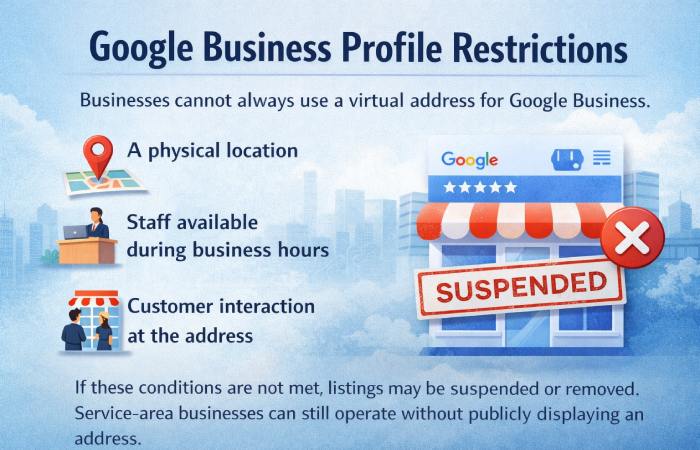
Businesses cannot always use a virtual address for Google Business Profile listings.
Google requires:
-
A physical location
-
Staff available during business hours
-
Customer interaction at the address
If these conditions are not met, listings may be suspended or removed.
Service-area businesses can still operate without publicly displaying an address.
Opening Bank Accounts
Banks often require real physical addresses due to Know Your Customer (KYC) regulations.
Virtual addresses may be rejected because:
-
They cannot verify business operations
-
They are registered as mail-forwarding locations
Some digital banks accept them, but traditional banks usually request a residential or office address.
When not to use a virtual business address
A virtual address wouldn’t be beneficial or cost-effective to traditional businesses with a physical office location. So instead, you can use your actual office address for everything you want.
However, you may only need a virtual office address if you want to expand to other cities where you don’t have office space.
Comparison Between Virtual Business Addresses and Physical Office Locations
| Feature | Virtual Business Address | Physical Office |
|---|---|---|
| Cost | Low | High |
| Professional Image | High | High |
| Physical Workspace | No | Yes |
| Legal Compliance | Limited in some industries | Full compliance |
| Flexibility | Very high | Limited |
| Remote Work | Ideal | Less suitable |
Summary
Virtual offices are best for:
-
Online businesses
-
Consultants
-
Freelancers
-
Startups
-
E-commerce companies
Case Study Showing Business Growth Using Virtual Offices (2025–2026)
Startup Growth Using Virtual Offices
A technology startup launched in 2025 adopted virtual offices across multiple cities.
Company Strategy
-
Headquarters: Virtual office in London
-
Expansion addresses: New York and Singapore
-
Remote workforce
Business Growth Graph (Example)
| Year | Revenue | Employees | Locations |
|---|---|---|---|
| 2025 | $500,000 | 10 | 1 |
| 2026 | $2,000,000 | 35 | 3 |
Graph interpretation:
Revenue and employee growth increased rapidly because the company avoided high office rental costs and invested more in technology and marketing.
Conclusion
Virtual business addresses have become an essential tool for modern entrepreneurs, remote workers, and startups. They provide a professional business identity at a fraction of the cost of traditional offices.
However, they are not suitable for every situation.
Businesses that require:
-
Physical inspections
-
In-person customer services
-
Banking verification
-
Regulatory compliance
may still need a physical office.
The best strategy for many companies is a hybrid model, combining a virtual address with occasional access to coworking spaces or meeting rooms.
As remote work continues to grow in 2025 and 2026, virtual business addresses will remain a key solution for cost-efficient business operations.
Disclaimer
This article is for educational and informational purposes only. Business laws and address requirements vary by country, state, and industry. Always consult a legal or tax professional before using a virtual business address for official registrations.
