
Table of Contents
Introduction
The Internet of Things (IoT) has transformed industries—from smart homes and healthcare to industrial automation and agriculture. With billions of connected devices worldwide, choosing the right programming language is critical for performance, scalability, and security.
IoT development is unique because it involves:
- Hardware-level programming (embedded systems)
- Cloud integration
- Real-time data processing
- Security and networking
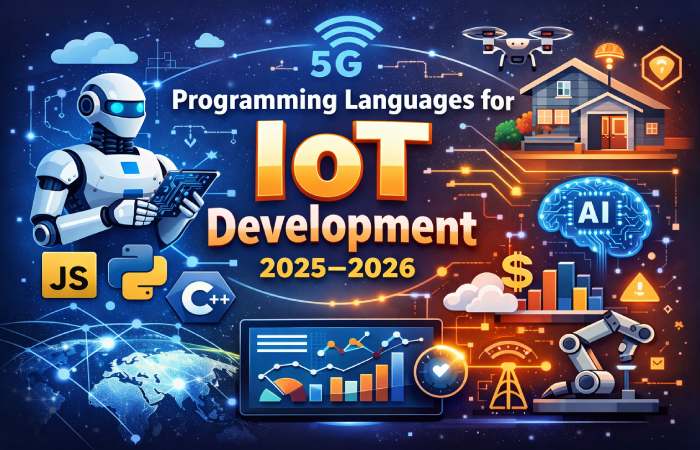
Languages like Python, C++, Java, and JavaScript dominate IoT due to their flexibility and ecosystem. Python is widely used for rapid prototyping, while C++ is preferred for low-level device control.
Additionally, IoT is expected to grow steadily with increasing adoption across industries, making it one of the most in-demand tech domains through 2030.
Programming – Connecting, communicating, and exchanging data with each other across a network of physical devices is the primary goal of the Internet of Things (IoT). The Internet of Things (IoT) comprises a wide range of components, including connectivity, integration, cloud computing, sensing, and many more. The technology may be used in various industries, including healthcare, retail, and more.
No one can argue with the notion that the Internet of Things (IoT) is the next big thing in the IT sector. The majority of developers and tech enthusiasts have already devoted themselves to mastering the new skills necessary to seek a career in the field. We’ve compiled a list of the most popular IoT programming languages in this post.
Top IoT Programming Specialists and Their Skills (Detailed Table)
Instead of just listing “specialists,” here’s a detailed breakdown of roles and required languages:
| Specialist Role | Key Programming Languages | Skills Required | Industry Use |
| Embedded Systems Engineer | C, C++ | Hardware interfacing, firmware | Smart devices, wearables |
| IoT Backend Developer | Java, Python, Node.js | APIs, cloud integration | Smart cities, SaaS IoT |
| Data Engineer (IoT) | Python, R | Data analytics, ML | Healthcare, agriculture |
| IoT Security Specialist | C, Rust, Python | Encryption, cybersecurity | Industrial IoT |
| Edge Computing Engineer | C++, Python | Real-time processing | Autonomous systems |
| Full Stack IoT Developer | JavaScript, Python | UI + backend integration | Smart homes |
Insight: C++ remains dominant for hardware-level programming, while Python and JavaScript dominate cloud and analytics layers.
1. Python
Programming with Python is one of the most popular platforms to use for IoT development. A functional and object-oriented programming language and a functional and structured programming language are both supported by this interpreted language. Because of its simpler syntax and improved code readability, the high-level programming language is a favorite among IoT developers.
2. Java
The portability of this language is one of its most well-known characteristics. Using a Java Virtual Machine, Java programmers can develop and debug their code on a work computer before deploying it to a target chip. Since JVMs are widely used, developers may run their code on many computers, not just smartphones and servers.
There are many different libraries needed to operate with Java. However, this language’s nature can be defined as “write once, run everywhere.”
3. Golang/Go
A Google-created open-source project, Golang or Go programming language, is a programming language. One of the oldest IoT programming languages was released in 2012 and offered under a BSD-style license.
When Rob Pike, Robert Griesemer, and Ken Thompson of Google’s software engineering team came up with the idea in 2007, the world noticed. They designed Golang to be a system programming language that is both simple to learn and extremely scalable.
Go has built-in concurrency and tools to maximize the exploitation of the system’s resources. Support from the cloud community and compatibility with multiple other platforms make it an ideal language for IoT devices.
4. Swift
Swift is an all-purpose programming language for Apple hardware. Programming in many paradigms is possible with this language. In addition to being highly safe and speedy, Swift can handle errors very well.
IoT developers working with Apple products should use Swift as their primary language of choice.
5. C or C++
C and C++ are the most popular languages when it comes to IoT devices. The C language came out on top for limited devices, while C++ came in second, according to a survey conducted by the IoT Developers Association. The mobility of these programming languages is well-known, and they are supported by the vast majority of IoT microcontrollers.
Cost of IoT Development and Developer Pricing (2025–2026 Table)
IoT development cost varies significantly depending on complexity, location, and technology stack.
Project Cost Estimates
| Project Type | Estimated Cost (USD) | Features |
| Basic IoT App | $20,000 – $40,000 | Simple sensors, dashboard |
| Mid-Level Solution | $50,000 – $100,000 | Cloud + mobile integration |
| Enterprise IoT System | $120,000 – $300,000+ | AI, analytics, automation |
(Source: industry estimates & developer discussions)
Developer Salary & Hiring Cost
| Location | Hourly Rate | Annual Salary |
| India | $25 – $50/hr | ₹3L – ₹5.5L/year |
| Eastern Europe | $40 – $70/hr | $40K – $80K |
| USA | $80 – $150/hr | $90K – $140K |
In India, the median IoT developer salary is around ₹4.15 lakh/year.
Global IoT Development Locations and Talent Distribution
| Region | Strength | Key Technologies | Cost Level |
| India | Affordable talent, growing market | Python, Java, C++ | Low |
| USA | Innovation hub | AI, cloud IoT | High |
| Germany | Industrial IoT (Industry 4.0) | Embedded systems | High |
| Eastern Europe | Skilled outsourcing | C++, Rust | Medium |
| China | Hardware manufacturing | Embedded C | Medium |
Key Insight: India is becoming a top outsourcing hub due to cost efficiency and increasing developer expertise.
Comparison of Top Programming Languages for IoT
| Language | Strength | Weakness | Best Use Case |
| Python | Easy, fast development | Slower execution | Prototyping, AI |
| C++ | High performance | Complex syntax | Embedded systems |
| Java | Platform independent | Heavy runtime | Enterprise IoT |
| JavaScript | Real-time apps | Limited hardware control | Dashboards |
| Rust | Secure, fast | New ecosystem | Secure IoT |
Key Takeaway:
- Use C++ for hardware
- Use Python for AI/data
- Use JavaScript for dashboards
Developer and Industry Reviews
What Experts Say
- Python is praised for its ease of learning and rapid development.
- C++ is valued for low-level control and performance efficiency.
- JavaScript (Node.js) is popular for real-time IoT dashboards.
Community Insight (Reddit Developers)
“C++ is ideal for IoT due to hardware control and efficiency.”
This aligns with industry standards where performance-critical systems rely heavily on compiled languages.
Case Study: IoT Development Growth
Scenario: Smart Agriculture IoT System
2025 Implementation
- Sensors: Soil moisture, temperature
- Language: Python + C++
- Cost: $40,000
- Output: Automated irrigation
2026 Upgrade
- Added AI predictions
- Edge computing integration
- Cost increased to $85,000
- Efficiency improved by 35%
New Updates and Trends
2025 Trends
- Rise of AI-integrated IoT
- Growth in 5G-enabled devices
- Increased use of Python and JavaScript
2026 Trends
- Adoption of Rust for secure IoT
- Expansion of edge computing
- More focus on cybersecurity
- Industrial IoT expansion
IoT demand is increasing due to AI, 5G, and automation technologies, driving higher salaries and adoption.
Conclusion
Programming languages are the backbone of IoT development. Choosing the right language depends on:
- Device type
- Performance needs
- Scalability
- Security
Best Strategy:
- Use C/C++ for embedded systems
- Use Python for analytics and AI
- Use JavaScript for user interfaces
With IoT evolving rapidly in 2025–2026, businesses must adopt modern stacks combining AI, cloud, and edge computing to stay competitive.
In a nutshell, the Internet of Objects has enabled processes, people, and things to communicate seamlessly. Every interaction between multiple technologies can be recorded, monitored, analyzed, and adjusted using digital systems. That’s something to keep an eye on in the years to come.
Also read: What Young People Can Face On The Internet?
